

Shopify Ad Benchmarks 2026: What Is a Good ROAS, CAC and CPA?
What is a good ROAS for a Shopify store in 2026? Above 1.86x on Meta, the median across nearly 35,000 ecommerce brands. A good blended CAC runs $53 to $91 depending on your vertical, and a good conversion rate starts around 3.2%. Your real target depends on your gross margin.
Every figure below is attributed to the report it came from, with its sample and period. Where two credible sources disagree, and they often do by a factor of two, both numbers appear with the reason why.
The 2026 Shopify Ad Benchmarks at a Glance
| Metric | 2026 benchmark | Source and sample |
|---|---|---|
| Meta median ROAS (ecommerce) | 1.86x, up 1.29% YoY | Triple Whale, ~35,000 brands, FY2025 |
| Google Ads median ROAS | 3.68x, down 10.03% YoY | Triple Whale, 18,000+ brands, FY2025 |
| Meta median CPM | $14.19, up 20.03% YoY | Triple Whale, FY2025 |
| Meta median CPA | $38.19, up 1.04% YoY | Triple Whale, FY2025 |
| Google Shopping CPC | $0.66 | Store Growers |
| Ecommerce Google Search CPC | $1.16 (vs $2.69 all-industry) | Store Growers |
| Blended ecommerce CAC | $53 to $91 across 13 verticals | First Page Sage, 80+ clients |
| Shopify conversion rate | 1.4% average, 4.7% top 10% | Littledata, ~2,800 stores |
| Cart abandonment | 70.22% | Baymard, 50 studies |
| Target LTV:CAC | around 3:1 | Shopify (guidance, not a study) |
What Is a Good ROAS for a Shopify Store?
What is a good ROAS for ecommerce on Meta? Above 1.86x, the 2025 median across nearly 35,000 brands measured by Triple Whale. Google Ads runs higher at 3.68x, because Shopping traffic arrives further down the funnel. But a median return on ad spend tells you almost nothing until you put it next to your margin.
Break-even ROAS is 1 divided by your gross margin. At 60% you break even at 1.67x. At 25% you need 4x before you have made a cent. A store hitting 2x can be comfortably profitable or quietly bleeding, and the dashboard looks identical either way.
The two platforms moved in opposite directions in 2025. Meta ROAS held roughly flat while Google Ads ROAS fell 10.03%, with Google conversion rates down 9.28% alongside it. If your Google performance dropped last year and Meta held, that is the market, not your account.
Meta ROAS by vertical spans 1.17x in Media and Publishing to 2.54x in Automotive across 15 industries. Google Shopping's spread is wider: Automotive 10.61x, Toys and Hobbies 8.82x, Electronics 5.99x, Jewelry 4.94x, Apparel 3.47x, per Store Growers using Sidecar data.
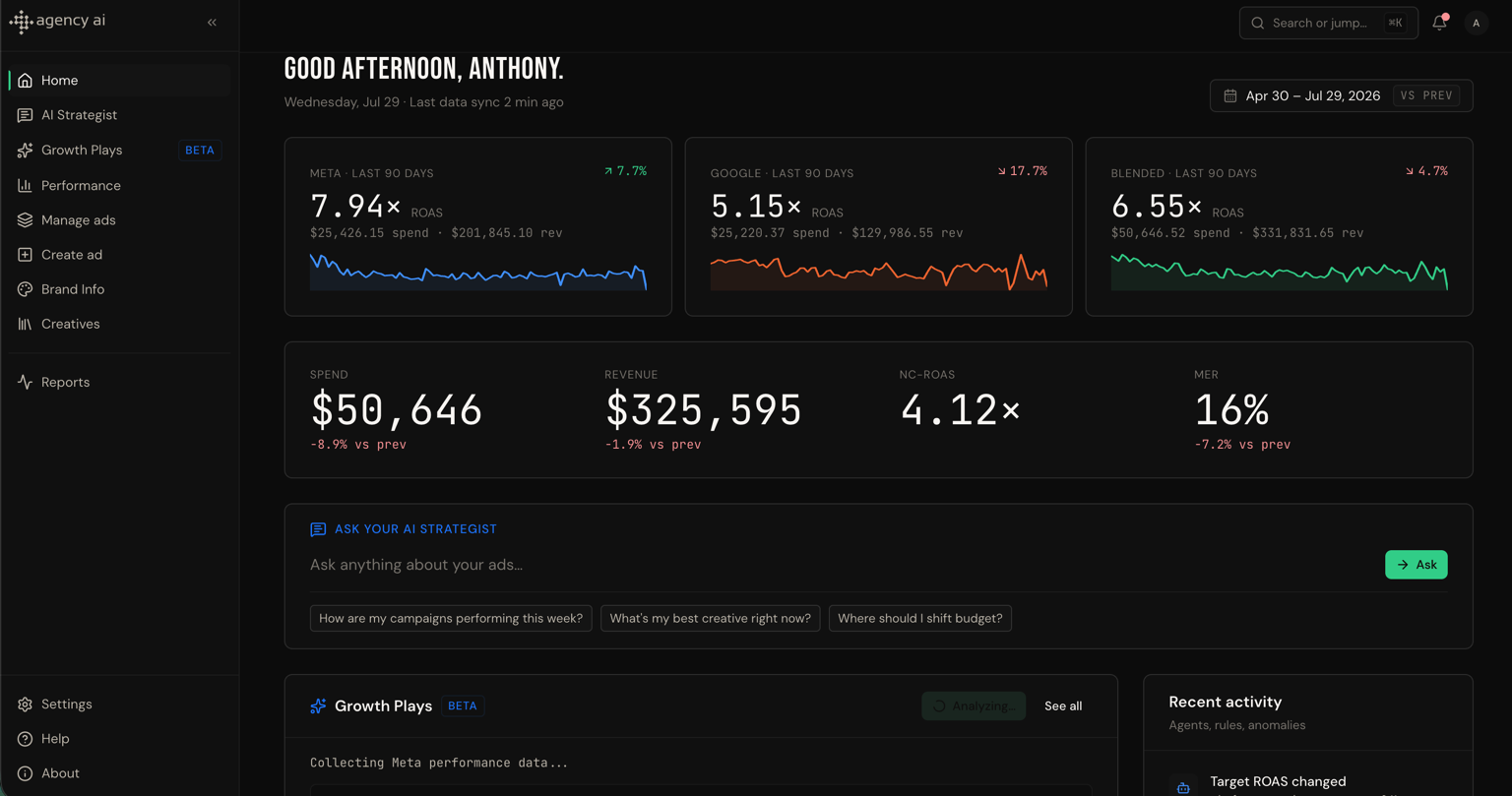
One caveat reframes all of it. Reported ROAS is not incremental ROAS. Cassandra analyzed 253 marketing mix models across 59 advertisers and $383 million in spend, and found platform-reported ROAS runs 2 to 5x higher than MMM-measured incremental return, depending on channel. The dashboard is a directional signal, not a P&L.
What Is a Good CAC for a Shopify Store?
Blended ecommerce CAC runs $53 to $91 across 13 verticals, per First Page Sage's 2026 report drawn from 80+ clients over five years. Food and beverage sits lowest at $53, consumer electronics highest at $76. A good customer acquisition cost is any figure where your LTV:CAC ratio clears roughly 3:1, Shopify's stated guidance.
Here is where most customer acquisition cost benchmark comparisons go wrong. First Page Sage measures blended CAC, total acquisition spend divided by new customers. Mobiloud measures paid CAC, media only. The numbers look comparable and are not.
Ecommerce CAC by vertical, paid media only:
| Vertical | Average paid CAC | Full range | LTV:CAC |
|---|---|---|---|
| Food and beverage | $45 to $53 | $25 to $80 | 4.5:1 |
| Beauty and personal care | $61 to $68 | $28 to $120 | 3.2:1 |
| Fashion and apparel | $66 to $72 | $32 to $250 | 2.5:1 |
| Electronics | $76 to $85 | see note | see note |
| Luxury goods | $175 | $120 to $400 | see note |
Source: Mobiloud, 2026. Note the fashion range: $32 to $250 around a $66 average. The spread inside a vertical beats the gap between verticals, so treat a vertical average as a starting point, not a target. Northbeam reported median first-time customer CAC rising nearly 9% year over year across its DTC brands while median MER fell, so the ecommerce customer acquisition cost picture is rising costs against flat efficiency.
What Is the Average CPA on Facebook Ads for Ecommerce?
Median Meta cost per acquisition for ecommerce was $38.19 in 2025, up 1.04%. Google Ads came in considerably cheaper at $23.74, though that rose 12.35% over the same period. Both are Triple Whale medians measured across ecommerce brands rather than all advertisers.
The vertical spread on ecommerce CPA is wide: $29.99 in Lifestyle and Boutique, the cheapest, to $49.48 in Electronics, which also carries the lowest conversion rate in that table.
What did not happen in 2025 is the interesting part. CPMs rose 20.03% while CPA rose just 1.04%, with conversion rates up 8.29% and click-through rates up 13.5%. Reach got a fifth more expensive and acquisition cost barely moved. Triple Whale publishes these figures without causal analysis, so the link is an inference rather than their finding.
How Much Do Facebook Ads Cost for a Shopify Store?
Meta's median CPM reached $14.19 in 2025, up from $11.82, the sharpest rise in years. Every vertical in Triple Whale's facebook ad benchmarks saw CPM increase, from $10.01 in Automotive to $20.70 in Health and Wellness. Median CTR was 2.19% and median CVR 1.6%. WordStream put traffic-objective CPC at $0.70.
Now hold that $14.19 next to this. Databox, measuring across 2,800+ contributing companies, publishes a median Meta CPM of $7.26. Same platform, same period, roughly half. Neither is wrong. Triple Whale samples ecommerce brands running meaningful spend; Databox samples everyone who connects an account.
What Do Google Ads Cost for a Shopify Store?
Ecommerce Google Search CPC averages $1.16 against $2.69 all-industry, and Google Shopping runs cheaper still at $0.66. For product-based stores, Shopping is usually where the efficient volume lives.
| Format | CPC | CPA |
|---|---|---|
| Google Shopping | $0.66 | $38.87 |
| Ecommerce Search | $1.16 | $45.27 |
| All-industry Search | $2.69 to $5.42 | $66.69 per lead |
Sources: Store Growers, WordStream by LocaliQ 2026. You will see the claim that Shopping is "87% cheaper than Search" in plenty of google ads benchmarks roundups. Treat it carefully: that compares an ecommerce Shopping CPC against an all-industry Search CPC inflated by legal services and dentistry. Like for like, the gap is real but nothing close to 87%.
On Performance Max, Google's own claim is narrower than the internet's version of it. Google states that advertisers moving from Standard Shopping to PMax drove a 25% increase in conversion value at a similar ROAS. That last phrase is load-bearing: the promise is volume at held efficiency, not an efficiency gain. Tinuiti's Q1 2026 data shows Shopping spend up 18% year over year on flat CPCs, with PMax now 67% of Shopping spend.
What Is a Good Conversion Rate on Shopify?
The average shopify conversion rate is 1.4%, measured by Littledata across nearly 2,800 stores. Above 3.2% puts you in the top 20%. Above 4.7% puts you in the top 10%. Those are the cleanest numbers in this article, because they come from one dataset with one methodology.
Shopify's own trailing-twelve-month data tells a different story by vertical:
| Vertical | Conversion rate |
|---|---|
| Food and beverage | 6.22% |
| Beauty and personal care | 4.94% |
| Fashion, accessories and apparel | 3.06% |
| Luxury and jewelry | 0.94% |
The variable that predicts conversion better than industry does is average order value. DTC Pages measured 21 Shopify stores with $417 million in combined annual revenue across 179 million sessions, and found stores under $60 AOV converting at a 2.42% median while stores above $200 converted at 0.79%. A 1% rate is excellent on a $400 product and a problem on a $40 one. Desktop ran 3.74% and mobile 2.29% in the same portfolio.
Across the whole market, Baymard's documented cart abandonment average is 70.22%, calculated from 50 studies. It has barely moved in a decade, which suggests it is structural rather than fixable.
Why Do These Benchmarks Disagree So Much?
Because they measure different things. Two credible sources can report the same metric and land 2x apart with neither being wrong. Confirm the definition before comparing your store to anything. This is the most common reason a founder panics over a number that is fine.
Myth: one of these numbers is right and the others are sloppy.
Reality: Databox reports a $7.26 Meta CPM, Triple Whale reports $14.19, same platform, same period. Both are accurate. The gap is the population sampled, not the arithmetic.
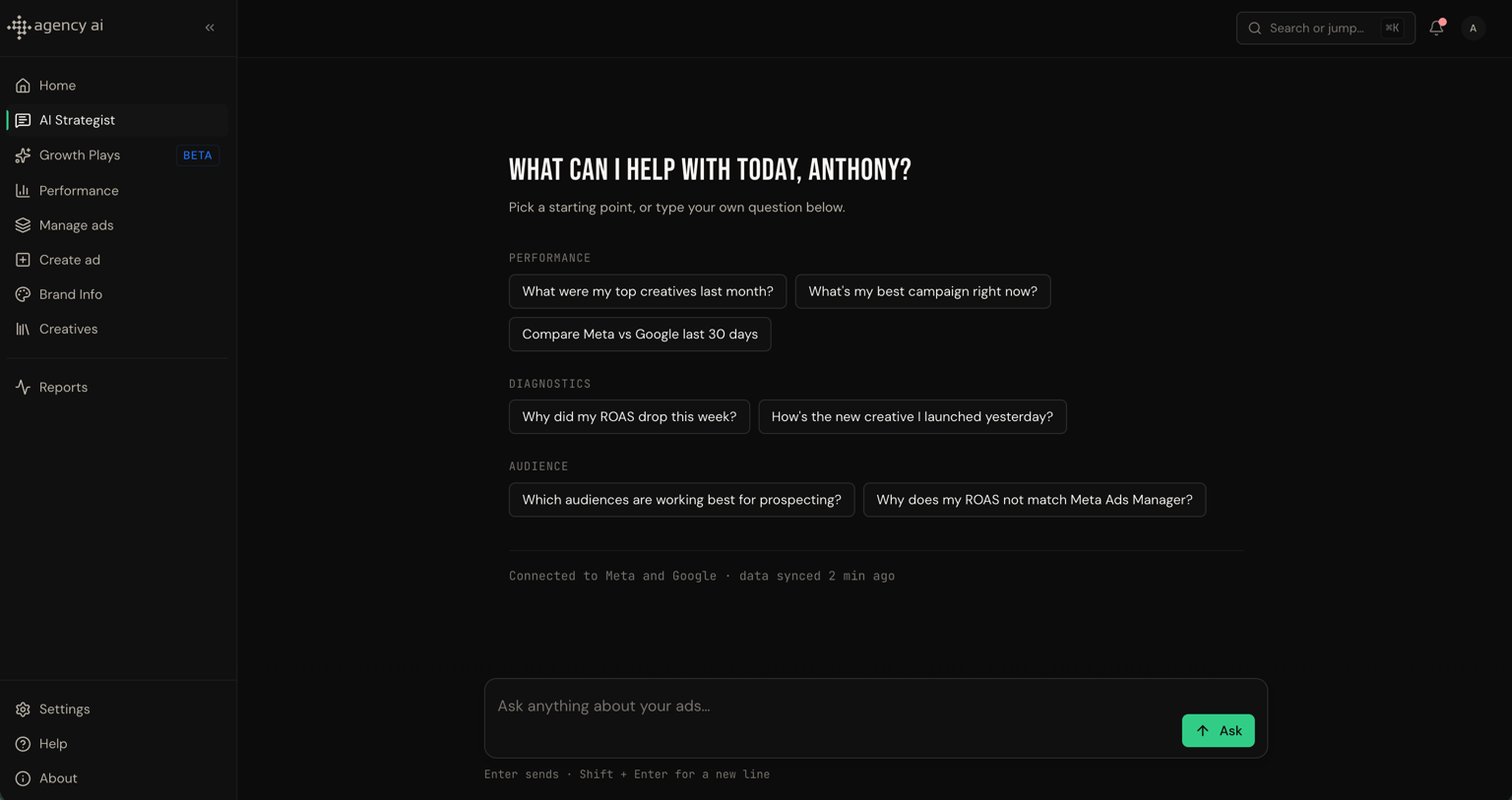
The mismatch is common enough that ad tools now treat it as a standard question, alongside week-to-week swings and cross-platform comparisons.
The definitions that matter most:
- CAC: blended vs paid. Blended divides all acquisition spend by new customers. Paid counts media only. First Page Sage publishes blended, Mobiloud publishes paid, and the tables are not interchangeable.
- CTR: all clicks vs link clicks. In one Databox dataset, CTR (All) is 1.90% and Link CTR 1.18%. The first counts post expansions and reactions; only the second reaches your site.
- CVR: which denominator. Triple Whale's 1.6% is ad-click-to-purchase inside Meta. Littledata's 1.4% is session-to-order across an entire store.
- ROAS: reported vs incremental. A 2 to 5x gap, per Cassandra's 253 marketing mix models.
- CPC: ecommerce vs all-industry. $1.16 versus $5.42. Any comparison mixing the two is broken.
- Category labels that look identical and are not. "Food and Drugs" is retail grocery and pharmacy. "Food and beverage DTC" is subscription coffee and supplements.
Pick one source, learn its methodology, and track your own trend against it. Your month-over-month movement is worth more than any table here.
How to Actually Improve These Numbers
Four levers move these benchmarks, roughly in order of impact.
Creative first. With CPMs up 20% and CTR up 13.5%, creative carries more of the outcome than it did two years ago. Cheap reach is gone. What you still control is whether the impression you paid $14.19 per thousand for earns the click.
Run Meta and Google as one funnel. Most stores pay twice to reach the same buyer, because the platforms optimize independently and neither knows what the other did. Coordinating budget and exclusions across both is high leverage, and almost nobody does it by hand because it never stops.
Use AI bidding, and read the claims precisely. Meta reports a 17% average improvement in cost per acquisition and a 32% average increase in return on ad spend for Advantage+ shopping campaigns. Google reports 25% more conversion value at a similar ROAS for PMax. Both are platform claims about platform products rather than independent measurement, but the direction is consistent enough to act on.
Then fix the post-click. Strong CTR with weak CVR means the problem is downstream: landing page, offer, mobile experience, checkout. Mobile is roughly 78% of visits and converts at 2.29% against desktop's 3.74%, so checkout friction on mobile is where most stores lose the money they just spent acquiring the visit.
To know how to lower customer acquisition cost in practice, work that list in order. Creative and funnel coordination move CAC further than bid tweaking.
Where Agency AI Fits
Those levers are not hard to understand. They are hard to run continuously. Coordinating two platforms as one funnel, refreshing creative before fatigue sets in, and adjusting against margin rather than reported ROAS is a full-time job, and it is the one most stores either skip or cover with a retainer.
Agency AI installs from the Shopify App Store and runs Meta and Google as one coordinated funnel through a 90+ rule agentic engine. Its AI studio generates ad copy and creative, building a full Meta ad in about two to three minutes rather than the ten-plus it takes in Ads Manager. It watches both accounts continuously and surfaces approval-ready changes measured against your break-even ROAS, so nothing moves your budget without you agreeing to it first. We compared it with six other Facebook ads apps for Shopify.
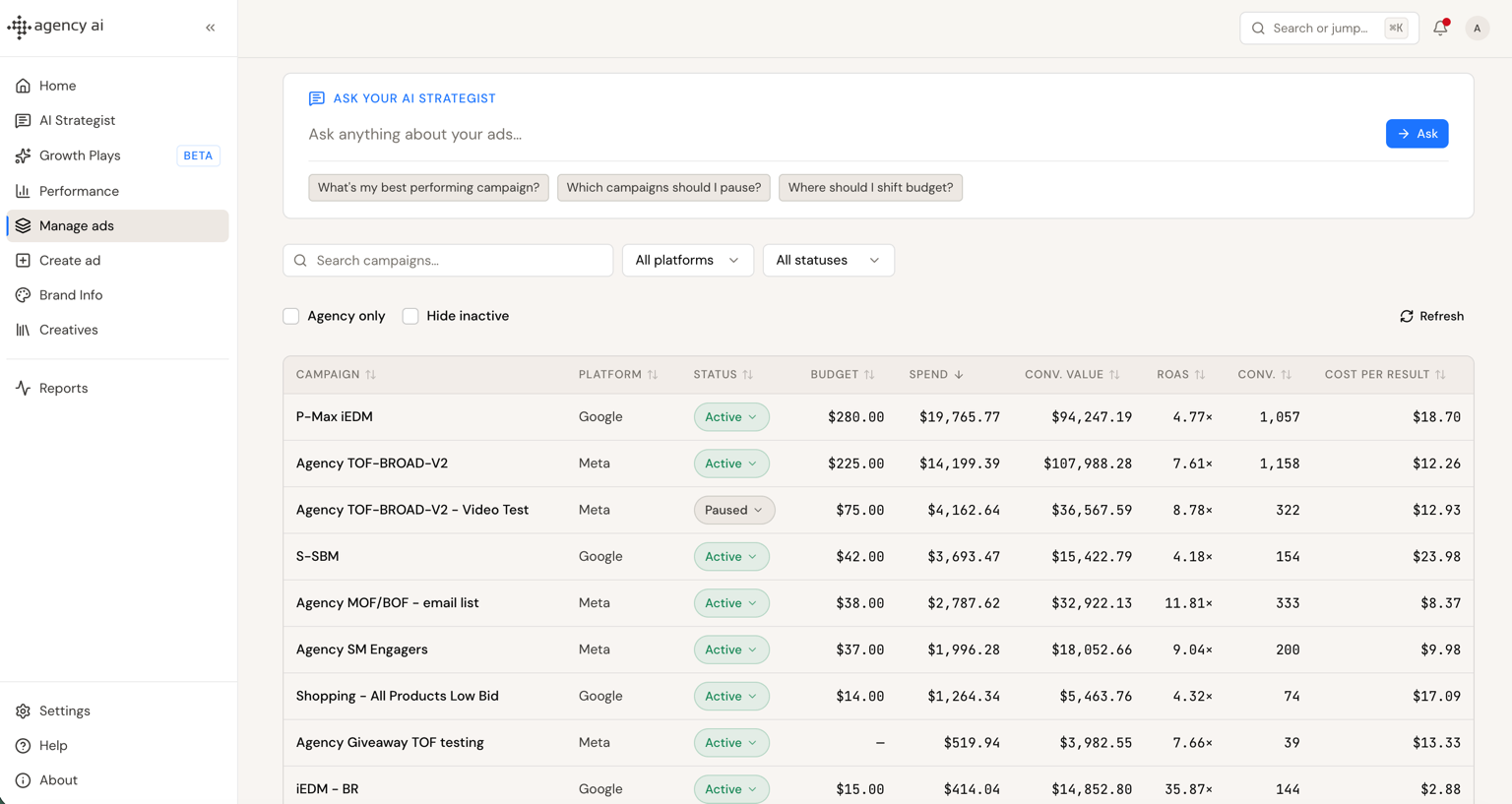
The point is not to replace your judgement about your own business. It is to run those levers continuously, the way an agency would, without the retainer.
Final Thoughts
Benchmarks are for orientation, not grading. The number that decides whether your advertising works is contribution margin after returns and discounts, and no industry median can tell you that.
Take three things from this page: read ROAS next to your gross margin, confirm the definition before comparing yourself to anyone, and watch your own trend line more closely than any table here.
Frequently Asked Questions
Sources
Triple Whale, Facebook and Google Ads Benchmarks by Industry (~35,000 and 18,000+ ecommerce brands, FY2025). Littledata, conversion benchmark (~2,800 Shopify stores). First Page Sage, ecommerce CAC 2026 (blended, 80+ clients). Mobiloud, ecommerce CAC by vertical 2026 (paid). DTC Pages, Q2 2026 (21 stores, $417M revenue, 179M+ sessions). Store Growers, Google Ads and Shopping benchmarks. WordStream by LocaliQ 2026. Databox, Facebook Ads benchmarks. Cassandra, Google Ads Benchmarks 2026 (253 marketing mix models, $383M spend). Tinuiti, Q1 2026. Baymard Institute, cart abandonment. Shopify, conversion rate by industry and LTV to CAC guidance. Northbeam, DTC unit economics. Meta and Google, platform claims on Advantage+ and Performance Max.
Figures are the most recent published at the time of writing and will shift. Last updated July 2026.
Free to install. Launch campaigns and pay nothing for your first 30 days.
